David M. Schwartz

Author, Speaker and now . . . Blogger!

  • Home
  • Blog Home
  • Math Moments
    • Your Child in Math Moments
  • Resources
    • Magic of a Million Activity Book
  • David Schwartz Visit
    • Organizing a David Schwartz Visit
    • Assemblies and Workshops for Children
    • MILLION MANIA… Preparing Students for a David Schwartz Visit
    • Care and Feeding of an Author (at least this one)
    • Publicizing David Schwartz's Visit to Your School
    • Book Sales and Autographing
    • Equipment Needs

Math-Lit for the Older Set

Written by David on January 29, 2010 - 0 Comments
Categories: Books, G is for Googol, I.N.K

I got an email the other day from a parent looking for good mathematical literature to interest and challenge older children. Is there any? Which books would I recommend?

Before I describe a few of my faves, I must point out, as I did at length in my INK post of May 28, 2008, that many educators have inspired intermediate grade, middle school and even high school students with picture books, using them as age-appropriate teaching tools. I believe my most successful mathematical picture books are those that can be used on many levels. In fact, when asked the target age for How Much is a Million?, I often say, “Preschool through high school.” Actually, it’s not true. I should say. “Preschool through college,” but that answer might sound overly smug. (I have twice met college professors who use my book when teaching about Avogadro’s number, a behemoth number critically important in understanding quantitative chemistry.) That said, I will mention a few books that probably wouldn’t make it into the 2nd grade math classroom but should be a staple of math classrooms or libraries serving upper elementary, middle school and high school students.

In The Number Devil by German author Hans Magnus Enzensberger, a middle school-age boy named Robert dreams of travels through the world of mathematics under the tutelage of an impish devil whom he at first finds annoying but gradually comes to enjoy and admire. At the start of the book, Robert is a mediocre and indifferent math student — no surprise, considering that his ho-hum teacher at school gives the students mathematical busywork without the least bit of mathematical inspiration. (His uncomprehending mother is no better: she believes a son who voluntarily speaks of mathematical concepts must be ill!) But Robert and the devil are on an irrepressible romp and together they challenge each other while developing plethora of mathematical concepts and meeting a pantheon of famous mathematicians. All names are whimsically disguised — Leonhard Euler becomes “Owl” (Eule in German translates to “owl” in English) and roots (as in square roots, cube roots, etc.) are called “rutabagas” (which are literal roots) — just two of many such examples. Figuring out the conventional words for the concepts at hand just adds to the devilish fun of this 1997 book which is well on its way to becoming a classic.

Flatland is not on its way to classic status: it’s already there. Like The Number Devil, it incorporates dreams but the concepts are geometrical rather than numerical. This novella, written in 1884 by English schoolmaster Edwin A. Abbott, is a pointed satire of closed-minded, hierarchical Victorian society but it is also, as Isaac Asimov put it, “The best introduction one can find into the manner of perceiving dimensions.” The story has been developed into several short films and a 2007 feature film; there have been TV episodes, a role-playing game and sequels by other authors.

The narrator of the original Flatland is a square named – ready? — A. Square. He lives in a two-dimensional world, Flatland, but dreams of visiting a one-dimensional world, Lineland, where he tries to convince the ignorant monarch of a second dimension but fails to open the ruler’s eyes to a universe beyond his familiar straight line domain. He also goes to one-dimensional Pointland inhabited by a monarch who is the sole inhabitant and, in fact, is the entire universe in and of himself! (He perceives any attempts at communication from the outside world to be his own thoughts.) Later, our narrator is visited be a three-dimensional sphere, which he finds incomprehensible until he accompanies Sphere to Spaceland. From there, the two discover that the leaders of Flatland know about Spaceland and a third dimension, but they prohibit their subjects from acknowledging it, under penalty of death or imprisonment. Square tries to convince Sphere of the possibility of fourth and fifth dimensions, but the notion is soundly rejected and Square is sent home in disgrace. It’s not a happy story but fascinating and uplifting in its own way, and, like the subject matter, the book has many dimensions.

Mathematics: A Human Endeavor by Harold R. Jacobs is a wide-ranging mathematics textbook so deliciously fun and fascinating that kids actually want to read it. Even more astonishing, their parents and teachers can’t put it down either. As a college senior, I discovered its first edition (it’s now it its third) while volunteering as an enrichment provider to a select group of very sharp fifth graders, and I was hooked. Jacobs covers the breadth of high school mathematics with an emphasis on the beauty and power and real-life relevance of each subject. Aptly-chosen cartoons made me and my students laugh outloud, and we immediately saw that the cartoons weren’t included just for the guffaws. “An improvement over the square wheel,” pronounces B.C in the caption of one drawing as he flaunts his great invention: a triangular wheel. “It eliminates one bump!”Jacobs shows how B.C.’s thinking is dead wrong, and in so doing, he develops principles of polygons and the mathematical concept of limit: as the number of sides grows and approaches infinity, the polygon approaches a circle — the “wheel” with no bumps (road surface willing!).

In lucid prose, the subjects range from algebra and geometry to probability, topology, statistics and more. Jacobs often shows how the math being taught is found not only in books but in life. This book has become a staple among alternative high schools and homeschoolers, but I find it so readable that it doesn’t have to be thought of as a textbook at all. Just the same, a teacher’s guide is available.

A major step down from the literary giants I’ve just described is my own picture book targeted at upper-elementary and middle school age children. G Is for Googol: A Math Alphabet Book is a potpourri of topics from “A is for Abacus” (proficient abacus users outcompete calculator users every time) to “Z is for Zillion” (not actually number, which provides an excuse to talk about what makes a number a number). Math-loving kids of all ages have found respite in its pages, and math teachers sometimes read from it to provide literary snacks on special days. It has spawned many a student-created alphabet-book as class projects. A 6th grade class in Colorado called theirs An Algabet Anthology by “The Awesome Accelerated Academics.” At first I thought the title had a typo but I later realized that “algabet” is just a play on “algebra.” Sixth grade humor. The word play continues to the final page:

THE END

We Hope This Book

Arithmetickled You Pink

Share your thoughts..

The Play’s The Thing

Written by David on December 21, 2009 - 0 Comments
Categories: I.N.K

The mother of a 7th grader in Oakland, CA, tells me that morning recess at her son’s middle school has been cut from twenty minutes to ten, and the entire recess, formerly held outdoors, is now limited to an indoor space. Even the theoretical 10 minutes is often whittled down to just a few minutes or none at all because teachers respond to the disruptive in-class behavior of a few students by holding the class through recess to make up for classroom delays.

This sorry state of affairs is not limited to the United States. I am just back from speaking at primary (elementary) schools in Australia. I had a few opportunities to interact with children on the playground and I was pleased to notice the great variety of types of play, and how there seemed to be a niche for everyone. Some activities engaged solitary children, others occupied pairs or small groups, and a few involved large numbers. Yet when I shared my approving observations with teachers, I learned that, as in the U.S., recess is an endangered species.

Studies consistently prove its value. In one set of experiments from the mid-1990s, researchers found that school children became less and less attentive the longer recess was delayed. Another experimental study found that “fourth-graders were more on-task and less fidgety in the classroom on days when they had had recess, with hyperactive children among those who benefited the most.” An article in the New York Times in February, 2009, cited a study of 11,000 third graders showing that recess mitigates children’s behavioral problems. (Consider the common punishment for misbehaving children: “No recess!”) And a meta-analysis of over 200 studies suggest that physical activity during the school day results in more, and better, mental activity.

For all their lip-service to the necessity of drawing on research-based teaching strategies, education authorities in the U.S. and Australia (and probably many other countries) don’t seem to care much about research on play. It is interesting that, by contrast, China launched a nationwide “Sunlight Sport” campaign in 2007, requesting that every school offer one hour of sports and games daily to every student.

I read about Chinese children’s play and the Sunshine Sport campaign in a fascinating Australian journal called Play and Folklore, co-edited by Dr. June Factor of the University of Melbourne, an author and folklorist who writes playful and play-filled books for both children and adults. I met June at a reading conference in California about 15 years ago, and I had the good fortune of visiting her in Australia during my recent trip.

The most wonderful thing about many of June’s books for children is that they are actually by children: she is merely the compiler, and what she has compiled is straight from the mouths of kids, whom she and her university students have observed, recorded and interviewed in school playgrounds. The researchers collected children’s games, rhymes, sayings, chants, riddles, jokes and secret languages in abundance. In 2000, she published an entertaining and enlightening lexicon, Kidspeak: A Dictionary of Australian Children’s Words, Games and Sayings. The two children depicted on the cover have harsh words for each other: “Nicky woop” says one in a speech bubble, to which the other retorts, “Drongo!” (Translation: “Go away!” and “Jerk!”)

June’s collections for young readers have been loved since 1983 when Far Out, Brussels Sprout came out. It has since been joined by Real Keen, Baked Bean…Unreal, Banana Peel…Okey Dokey, Karaoke, and others in the Far Out! series. All offer a rich sampling of the linguistic range and complexity of Australian children’s vernacular language. “It’s children’s own literature,” says June, “handed down across many generations, sometimes across centuries. It’s a bridge across generations, common to childhood, not just contemporary childhood.” From Far Out, Brussels Sprout:

Quickly, quickly, I feel sickly.

Hasten, hasten, get the basin.

Ker plop!

Get the mop!

—————

Mary had a little lamb

She kept it in a closet.

And every time she let it out

It left a small deposit.

They’re not always the most proper ditties in the world. As a result, a decade ago June learned that she was the second-most censored author in Australian school libraries, after Judy Blume. She told me this with more than a hint of irony, considering that the censors were trying to save innocent children from their own words. “It tells you much about the power of adult prudery and unease about the human body and its functions — but, I hasten to add, not nearly as much as in the United States!”

Often, these censorship cases have been dismissed when the schools discovered how many families already owned the challenged books. But what disturbs June more than censors in the libraries is timekeepers on the playgrounds. “Increasingly, playtime is being restricted,” says Australia’s leading observer of playtime. “It’s happening in America and it’s happening here.” In the U.S., where we once feared a “red menace” from Asia, there now seems to be fear that Asian countries including China will overtake us not militarily but intellectually and economically. If it comes to pass, browbeating analysts should consider how our schools rejected the demonstrable benefits of playtime. American education authorities could have the demise of recess to blame for our fall from intellectual eminence. Some might call them drongos!


The mother of a 7th grader in Oakland, CA, tells me that morning recess at her son’s middle school has been cut from twenty minutes to ten, and the entire recess, formerly held outdoors, is now limited to an indoor space. Even the theoretical 10 minutes is often whittled down to just a few minutes or none at all because teachers respond to the disruptive in-class behavior of a few students by holding the class through recess to make up for classroom delays.

This sorry state of affairs is not limited to the United States. I am just back from speaking at primary (elementary) schools in Australia. I had a few opportunities to interact with children on the playground and I was pleased to notice the great variety of types of play, and how there seemed to be a niche for everyone. Some activities engaged solitary children, others occupied pairs or small groups, and a few involved large numbers. Yet when I shared my approving observations with teachers, I learned that, as in the U.S., recess is an endangered species.

Studies consistently prove its value. In one set of experiments from the mid-1990s, researchers found that school children became less and less attentive the longer recess was delayed. Another experimental study found that “fourth-graders were more on-task and less fidgety in the classroom on days when they had had recess, with hyperactive children among those who benefited the most.” An article in the New York Times in February, 2009, cited a study of 11,000 third graders showing that recess mitigates children’s behavioral problems. (Consider the common punishment for misbehaving children: “No recess!”) And a meta-analysis of over 200 studies suggest that physical activity during the school day results in more, and better, mental activity.

For all their lip-service to the necessity of drawing on research-based teaching strategies, education authorities in the U.S. and Australia (and probably many other countries) don’t seem to care much about research on play. It is interesting that, by contrast, China launched a nationwide “Sunlight Sport” campaign in 2007, requesting that every school offer one hour of sports and games daily to every student.

I read about Chinese children’s play and the Sunshine Sport campaign in a fascinating Australian journal called Play and Folklore, co-edited by Dr. June Factor of the University of Melbourne, an author and folklorist who writes playful and play-filled books for both children and adults. I met June at a reading conference in California about 15 years ago, and I had the good fortune of visiting her in Australia during my recent trip.

The most wonderful thing about many of June’s books for children is that they are actually by children: she is merely the compiler, and what she has compiled is straight from the mouths of kids, whom she and her university students have observed, recorded and interviewed in school playgrounds. The researchers collected children’s games, rhymes, sayings, chants, riddles, jokes and secret languages in abundance. In 2000, she published an entertaining and enlightening lexicon, Kidspeak: A Dictionary of Australian Children’s Words, Games and Sayings. The two children depicted on the cover have harsh words for each other: “Nicky woop” says one in a speech bubble, to which the other retorts, “Drongo!” (Translation: “Go away!” and “Jerk!”)

June’s collections for young readers have been loved since 1983 when Far Out, Brussels Sprout came out. It has since been joined by Real Keen, Baked Bean…Unreal, Banana Peel…Okey Dokey, Karaoke, and others in the Far Out! series. All offer a rich sampling of the linguistic range and complexity of Australian children’s vernacular language. “It’s children’s own literature,” says June, “handed down across many generations, sometimes across centuries. It’s a bridge across generations, common to childhood, not just contemporary childhood.” From Far Out, Brussels Sprout:

Quickly, quickly, I feel sickly.

Hasten, hasten, get the basin.

Ker plop!

Get the mop!

—————

Mary had a little lamb

She kept it in a closet.

And every time she let it out

It left a small deposit.

They’re not always the most proper ditties in the world. As a result, a decade ago June learned that she was the second-most censored author in Australian school libraries, after Judy Blume. She told me this with more than a hint of irony, considering that the censors were trying to save innocent children from their own words. “It tells you much about the power of adult prudery and unease about the human body and its functions — but, I hasten to add, not nearly as much as in the United States!”

Often, these censorship cases have been dismissed when the schools discovered how many families already owned the challenged books. But what disturbs June more than censors in the libraries is timekeepers on the playgrounds. “Increasingly, playtime is being restricted,” says Australia’s leading observer of playtime. “It’s happening in America and it’s happening here.” In the U.S., where we once feared a “red menace” from Asia, there now seems to be fear that Asian countries including China will overtake us not militarily but intellectually and economically. If it comes to pass, browbeating analysts should consider how our schools rejected the demonstrable benefits of playtime. American education authorities could have the demise of recess to blame for our fall from intellectual eminence. Some might call them drongos!

Share your thoughts..

On Googols and Google, Googolplex and Infinity: The Truth About Big Numbers

Written by David on October 26, 2009 - 0 Comments
Categories: I.N.K

When I was in high school, I read a book called Infinity: Beyond the Beyond the Beyond. I don’t remember much about it, but I’ll never forget the title. The concept of infinity in its … well, infiniteness… can keep my mind occupied for a long time. And the idea of going “beyond the beyond” — and then beyond that! — provided more delicious food for thought. I sometimes think about that title and the mind-candy of endlessness when I’m speaking at a school, as I was last week in West Chester, PA, and someone asked, “What’s the biggest number?” It’s a question I often hear. The conversation usually goes something like this:

Child: What’s the biggest number in the whole wide world?

David: Do you think there is such a thing as the biggest number?

Audience: half “Yes,” half “No”

David: Will someone please tell me what you think the biggest number is.

Children, variously: billion, trillion, quadrillion, quintillion, googol, googolplex, etc.

David: Hang on. Let’s suppose you think “quintillion” is the biggest number. Then what about “quintillion-and-one”? Isn’t that bigger? And if that’s the biggest, what about “quintillion-and-two” — even bigger, right?

This usually leads to a triumphant retort about an enormous number familiar to many children (much less familiar to their parents and teachers):

Child: Googol has to be the biggest!

David: What’s a googol?

Many children know that “googol” is the name for a very large number — a one followed by a hundred zeros. This is an exciting concept. In my book G is for Googol: A Math Alphabet Book, I tell the story of how “googol” got its name from a nine-year old boy. Surely it is tempting to call googol “the biggest number,” but that’s a non-starter.

Me: If you think googol is the biggest number, then what about googol-and-one? Or two googol? Or a googol googol?

Almost inevitably, at this point someone proffers an even bigger number, “googolplex.” It is true that the word “googolplex” was coined to mean a one followed by a googol zeros. It’s way bigger than a measly googol! Googolplex may well designate the largest number named with a single word, but of course that doesn’t make it the biggest number. In a last-ditch effort to hold onto the hope that there is indeed such a thing as the largest number…

Child: Infinity! Nothing is larger than infinity!

True enough, but there is nothing as large as infinity either: infinity is not a number. It denotes endlessness. A number designates a specific amount.

So, finally we get to a consensus: There is no such thing as the largest number. Yet numbers as large as googol or googolplex continue to tantalize, and well they should. To me the most fascinating thing about googol is how incredibly enormous it actually is. Writing those hundred zeros, while tedious, would take only a minute or two, yet the amount represented is, as I stated in G is for Googol, “more than the number of hairs on the head of everyone in the world, more than the number of blades of grass on all the lawns of the world, more than the number of grains of sand on all the beaches of the world — even more than the number of atoms in the universe.”

The estimated number of atoms is a one followed by 72 zeros (ten to the 72nd power, but I can’t do exponents in this blog). Let’s suppose the astrophysicists who estimated the number of atoms are way off. For the moment, let’s imagine that the actual (though unknowable) number of atoms is a hundred times as what they claim. So it would be a one followed by 74 zeros —still way, way, way less than a googol.

The number “googol” is, in fact, useless — except as food for a hungry mathematical mind. And it is an especially nourishing numerical treat for young hungry minds. In fact, a child possessing just such a hungry young mind corrected me when I once said, “There isn’t a googol of anything, anywhere.” The boy countered, “There are more than a googol numbers. The number of numbers is infinite.” Right he was! Now I modify the statement: “There isn’t a googol of any physical object.”

I am less enthusiastic about the point that was made by sixth graders in a class that sent me a stack of letters. All had the same basic theme, reflected by this one:

Dear Mr. Schwartz,

How do you know how many hairs are on the head of every person in the world? You probably haven’t met every person in the world. Even if you have, babies are being born every minute. People are losing hair every day!

No argument there but, unfortunately, this class didn’t seem to have a good understanding of the importance (and legitimacy) of estimation.

Now, with the ascendancy of a certain multi-billion dollar online enterprise, it is necessary for me to include in any discussion of googol the following important inequality, lest there be confusion:

It is interesting to note that the item on the right was the result of a spelling error. When Larry Page and his friends were choosing a name for a start-up company, he attempted to name it after the huge number “googol.” Instead, he committed what is probably the most famous (and lucrative) misspelling in history. Regardless, there is absolutely no doubt that both “googol” and “google” are mighty big.

Share your thoughts..

Messing About in Libraries: The Delectable Art of Browsing

Written by David on September 28, 2009 - 0 Comments
Categories: I.N.K

To many of us, it’s almost unthinkable to imagine researching anything before the advent of the internet. Discovery of information before the era of google seems as onerous as hauling water out of a well. So seduced have we been by the simplicity and effectiveness of entering a few words into the rectangle at the top of the screen and — wowza! — dozens, hundreds or thousands of “hits” come up. If none is quite right, just change the search terms a bit and try again. For researchers, it’s like winning the lottery again and again.

But. . . you knew there would be a “but”. . . are we depriving ourselves of anything worthwhile when we boil the art of research down to finding 30,000 google hits in 18 microseconds? I would maintain that we are, for several reasons, and I am going to write about one of them: browsing. Sometimes there is both pleasure and success to be found by poking around in the shelves of libraries or bookstores, just to see what we might find.A few years ago, I wrote G is for Googol: A Math Alphabet Book, a potpourri of enjoyable mathematical ideas in an ABC format. Unlike the many alphabet books written for young children, this one is directed at readers in the intermediate and middle school grades (as is its sequel, Q is for Quark: A Science Alphabet Book). So how am I going to fill 26 slots with delightful math? Many entries popped into my mind right away. “A” is going to be for “abacus” because I love the fact that proficient abacus users can calculate lengthy addition or subtraction problems faster than the fastest calculator user. “Z” is going to be for “zillion” because it’s not a number at all but people often don’t realize that, so by discussing the difference between real numbers that end in “illion” and fake ones, I can discuss the actual meaning of number. As for what’s going to come in between A and Z, I had lots of ideas but not enough to fill out the book, so. . . let’s browse the library!

And so it was that I stumbled across Maps, Tracks and the Bridges of Königsberg: A Book About Networks by Michael Holt, a 1975 picture book that was one of many in the now sadly defunct “Young Math” series from the now sadly defunct publishing company, Thomas Y. Crowell. What fun! A great “K” word — Königsberg. I had heard about the dilemma that the residents of Königsberg, Germany, had tried to solve — to see if they could walk across each of their city’s seven bridges exactly once (all had to be crossed once and none could be re-crossed). No one could figure out a way to do it, but for centuries they were taunted by the prospect that a hidden solution eluded them. Finally the mathematician Leonhard Euler developed the postulates and theorems of a new branch of mathematics now known as graph theory or network theory in order to solve the Königsberg bridge problem. His goal was to figure out how to walk the bridges, or to prove it impossible. He succeeded not only in why the seven Königsberg bridges could not be walked once time each, but under what circumstances it could or could not be done for any network of bridges. Network theory not only proved to have many applications (useful, for example, in designing networks of cables) but it also laid the foundation for another branch of mathematics, topology. For me, as a researcher and writer, the cool thing is that I wouldn’t have thought of including the bridges of Königsberg in G is for Googol if I hadn’t bumped into them in Holt’s book on the shelves of a school library during a break between two assembly programs.

So that was an example of browsing, more-or-less aimlessly, to see what I could find and how I could tie it in. But there is another, more directed, way that browsing the shelves has proved fruitful in my research. It’s when I know what I’m looking for but neither google, for all its power, nor the library catalog nor anyone or anything else can tell me where to find it. For example. . .

Recently I have been doing research for an upcoming book called Where in the Wild? Mysteries in Nature Concealed. . . and Revealed, the next book in the series that began with Where in the Wlld? Camouflaged Creatures Concealed… and Revealed. One of the entries in What in the Wild? will be about the diggings of a star-nosed mole, a small mammal whose activities leave unwelcome mounds of soil on lawns and pastures. Moles, whether star-nosed or not, are usually not loved by landowners whose property they think of as their own.

Books and websites about moles turned out to be informative but a bit dull, focused on the minutia of their biology or harsh methods of putting an end to them and their excavations. So I wondered if I could find an interesting book with a section about moles. My initial searches in google and the public library catalog turned up no such book, probably because any that existed did not have the word “mole” in the title or subtitle or as one of the subject terms entered into the Library of Congress Cataloging-in-Publication data. Still, I figured that at least one such book must exist. I would employ a more venerable method of research.

And so it was that I found myself on hands and knees in the Rockridge branch of the Oakland Public Library, exploring the bottom shelf of the 596s just to see what I could find.

Within a few minutes, I had walked my fingers to Every Creeping Thing: True Tales of Faintly Repulsive Wildlife by Richard Conniff. The title seemed promising, and sure enough the table of contents led me to a chapter called “Notes from the Underground” — about moles. And guess what: star-nosed moles have a starring role! Conniff describes this creature in a most quotable way as a mole that “looks as if it’s got a sea anemone stuck on its snout.” And from there followed all kinds of fascinating information about the critters themselves and a colorful curmudgeon (of the human variety) who pursues them at the behest of disgruntled landowners in England. Once again, browsing trumped google!

The other day, a student at Landstuhl Elementary/Middle School on the U.S. Army base in Landstuhl, Germany, asked me the secret of success in researching books, and I told him a few things I thought of on the spot, but it didn’t occur to me at the time to tell him what I am saying here. To rewrite Kenneth Grahame’s delightful line (which, as it happens, was spoken by the character Mole in Wind in the Willows), “There is nothing—absolutely nothing—half so much worth doing as messing about in boats.” In this case, Grahame’s ode to blissful aimlessness might be rewritten for researchers as “There is nothing so delightful — or fruitful — as messing about in libraries.”

Share your thoughts..

The Truth — But Which Truth?

Written by David on August 24, 2009 - 0 Comments
Categories: General


I’ve been working on What in the Wild? Secrets of Nature Concealed . . . and Revealed (a sequel to Where in the Wild? and the soon-to-be-released Where Else in the Wild?). One of nature’s secrets to be discussed is the nest holes of kingfishers, those handsome, crested birds of watery places who burrow into the riverbanks to make their nests. How deep? It turns out there is no clear answer to this question, as I discovered in my research, which led to some ruminations that will be the subject of this post.

The authors of Wildlife and Plants, 3rd edition (Marshall Cavendish Reference) write that the nest tunnels are “3-7 feet long.” In Water Birds of California, author Howard L. Cogswell says “3 to 6 feet (even 10),” while World Book Encyclopedia reports “4-15 feet.” So which is it?

Those who read non-fiction often seem to have the impression that facts are facts. Period. The writer of non-fiction must merely learn them and report them, and that’s that. I’ve gotten this attitude often from children, egged on by the adults in their lives. “You wrote X, but we read Y in another book. Who is right and who is wrong?” Cheers for the author of truth. Jeers for the liars. But in reality, the depth of kingfisher tunnels (and many other facts) are unknowable. It might be instructive to consider how the figures above have come to light.

Over 200 or so years of American ornithological research, what percentage of kingfisher nests have been measured? I’d guess a sliver of a fraction of one percent. That alone tells us something: we don’t have a very strong sample here. And of those that have been measured, what fraction of the locations of kingfisher nests across North America have been measured? Another small fraction. Is there a wide variation in tunnel depths? It’s unlikely we know. Would different average lengths be found from Florida to Washington, from southern California to northern Maine? Possibly, but who knows? Are the tunnel lengths longer where the birds are digging into a softer material, shorter in a harder material? We don’t know. Or longer in one climate than another. It’s unlikely anyone would ever fund a study to find out, and probably for good reason.

So that’s a point: does it really matter? I can’t think of a good reason to study such a subject exhaustively. But if a question has not been studied in a statistically responsible way, we can’t really know the answer, can we? We can take a stab at it to get a general idea. So any of the above reported lengths is probably as good as any other. If someone found a nest burrow 15 feet long, it’s worth marveling at such a feat on the part of these birds. But overall it probably doesn’t make much difference whether the tunnels usually range from 3-6 feet or 4-10 feet, and whether the maximum is 10 or 15. So no one is out there doing studies to find out… and we may never find out.

My point is that facts are a much squirmier subject than many people realize, and it would be instructive for readers and thinkers to keep that in mind. One manifestation of this uncertainty is found in the common frustration at diverse and changing health recommendations. People blame science. I think they would do better to modify their expectations.

In an article called “The Fisher King,” in the August-September 2009 issue of National Wildlife, respected naturalist and author Les Line describes kingfishers and their nesting habits but does not mention any measurements for how deep their nest tunnels can be. Perhaps Mr. Line is onto something. But I do find myself wanting to hang some kind of measurement on the subject. So, I am willing to accept the varied figures I do find, knowing that no definitive numbers can be stated, and savoring a certain tantalizing deliciousness in the uncertainty.

Share your thoughts..

A "Super" Find

Written by David on July 27, 2009 - 0 Comments
Categories: Books, Super Grandpa

Way back a few centuries ago in the mid-1980s, long before anyone had ever heard the word “internet,” I was assigned to write an article for Smithsonian magazine on the decline of a once-loved American institution, the drug store soda fountain. The research for my story led me to seek newspaper and magazine articles from the heyday of soda fountains in the early- and mid-20th century.

If you are of a certain age, you will understand what I mean when I say that this endeavor resulted in my spending many hours in a public library squinting through a gargantuan, eye-straining machine known as a microfilm reader. If you are younger than that, herewith a brief explanation: to make back issues of certain magazines and newspapers accessible for years to come, a few companies were in the business of photographing the publications, page by page, and printing them onto acetate film in a much reduced size.

The film was called microfilm and in order to actually read it, a researcher could put the film into a machine called a microfilm reader and turn a cranking device (later replaced by an electric motor) in order to scroll to the section being sought. Lenses magnified the film onto a screen. Needless to say, it was no easy feat to find the right section and you had to watch unwanted pages whiz by, often zipping past the part you wanted. It was a pain in the . . . eyes. But who knew that such things as personal computers and internet browsers and search engines and digital archives would make the job a lot easier if only we were willing to wait a few decades?

Despite the trials of research by microfilm (and, slightly later, microfiche, a close cousin of microfilm that used flat sheets of film instead of rolls, thus avoiding the need for scrolling), it had some advantages. When you looked for an article in the New York Times about an especially popular soda fountain in Queens, as I did, you didn’t just get that article in isolation, but you got a glimpse into the world of 1951, as captured on the pages of the Times. There were other articles on the politics and culture and society and sporting events of the day, and there were advertisements that presented the tenor of the times as well as anything a journalist could have written. (In the course of reading about that Queens soda fountain, for example, I learned that big shiny luxury cars were selling for under $2,000. I reached for my credit card but then remembered that there were no credit cards back then.)

In the course of my research on soda fountains, conducted on the microfilm reader at the Wallingford (CT) Public Library, I stumbled upon a very short article, a space-filler, positioned on a back page of the New York Times of July 8, 1951. It briefly told the story of a 66-year old Swedish grandfather named Gustaf Håkansson who had just completed a 1,000-mile bicycle race despite having been barred from the race on account of his age. (How laughable that is in the context of a modern era in which athletes ten or fifteen years older than Gustaf routinely complete grueling races of many kinds — but this was the early 1950s). Hakansson had, in fact, started his personal race well ahead of the other racers and, 158 hours 20 minutes later, he finished to the rapturous cheers of thousands of fans who had turned out just to see him — the official racers weren’t due in for another day!

Gustaf’s story enchanted me, a lifelong bicycle lover, and I decided it needed to be told in its stereotype-bashing entirety. First, of course, I had to find out the story in its entirety.

Using The Reader’s Guide to Periodic Literature, an index that was then a staple on the reference shelves of libraries, I was able to find a more lengthy article about Gustaf in a long-defunct magazine called Lifetime Living. The article filled in some of the details, but I thought I’d need even more if I wanted to get into the mind of Gustaf and the psyche of his adoring fans. I hoped to see why he is, even to this day, remembered as a hero in Sweden.

Luckily, I had a Swedish friend living in the States who was getting ready to visit her family over the holidays. She offered to look in old Swedish newspapers for articles on the bushy-bearded bicyclist. She found several good ones and actually translated them into English for me. Another friend, studying at the University of Lund in Sweden, did further research with the help of a librarian friend.

The result was my picture book Supergrandpa, illustrated by Bert Dodson, later republished as Super Grandpa (with an audio CD of me reading the story with Swedish fiddle music in the background). In telling Gustaf’s story, I decided to “embroider” the actual facts to add to the dramatic tension, but in a page of back matter, I explained what actually happened.

To me, the most provocative lesson of this story is not about a bicycle ride in Sweden more than half a century ago. It is about differences in research methods between the internet era and the microfilm era. I’ll take the enormous power of the internet over the squinting inefficiency of microfilm readers any day. But let us not forget that sometimes the forgotten ways had their own power. Had I not been seduced by the charm of an old newspaper, the story of Gustaf Håkansson would probably still be buried in the back pages of a paper published on July 8th, 1951, and hardly noticed after July 9th.

Share your thoughts..

Paean to a Publisher

Written by David on May 25, 2009 - 0 Comments
Categories: General

Today is Memorial Day and I am in the mood to memorialize a publisher. Not a publisher that has died, fortunately (though many worthy ones have), but a publisher that is in transition. I don’t know whether the transition will transform it, but I know what I like about the way it used to be and I’m going to celebrate that here.

Why would I use this forum to talk about a publisher? Because I often meet educators with a passionate interest in children’s literature and I have found that many want to understand the relationship between author and publisher. (Actually, I know plenty of authors who would like to understand the relationship between their publishers and themselves!) Whereas children ask authors, “Where do you get your ideas?” and “How old are you?” their teachers tend to ask, “Do you get to choose your illustrators?” or “How hard is it to get an editor to read your manuscript?”

My six publishers come in three sizes: small, medium and large. About two months ago, one of the small ones, Ten Speed Press of Berkeley, CA, was bought by one of the world’s largest media conglomerates. Ten Speed Press and its children’s book division, Tricycle Press, are now part of Random House of New York, a division of Bertelsmann AG of Germany. So, for those who are interested in the inside scoop on the publishing world, I will dish up a few scoops as I pay tribute to Tricycle Press. I do not know how, or if, things will change at Tricycle, but from the perspective of an author, I do know what I loved about the old Tricycle Press. I’ll share these thoughts by answering the kinds of questions I have heard from teachers who are curious about authors interacting with publishers.

“Do you get to choose your illustrators?”

— Answer for most publishers: No. End of story.

— Answer for Tricycle Press: No… and yes. Of course Tricycle gets the final decision. But I have had major input. When Tricycle bought my manuscript G Is for Googol: A Math Alphabet Book, editor-in-chief Nicole Geiger asked if I had any thoughts about the illustrator. (To be consulted on such a decision was in itself remarkable.) I admired Marissa Moss’s light-hearted but detailed illustrations, so I suggested that Nicole consider Marissa, who had already published several books with Tricycle. A week later, Marissa was offered the job, and she accepted. When the sequel to Googol, called Q Is for Quark: A Science Alphabet Book, was ready for publication and Marissa was busy with other things, I introduced Nicole to Kim Doner. I had just met Kim in Tulsa and I thought that the bold humor in her illustrations would be perfect for my book. She was little known outside of Oklahoma but I felt she deserved much wider recognition. Nicole sent her a “trial assignment” (an invitation to illustrate one small section of the book for the editors’ perusal) and sure enough, Kim made the grade. Her pictures add immeasurably to my book, and she has since illustrated a number of titles by other authors for Tricycle.

“Do you get to work with the illustrator while he/she is working on your book?”

— Answer for most publishers: Not really. I sometimes get to see sketches and make comments that may or may not be conveyed to the illustrator.

— Answer for Tricycle Press: While I don’t work with the illustrator (i.e., I do not visit his or her studio and talk about the work in progress), I get to see the art at various stages in its production and my comments, relayed through the editor, are taken seriously. When Kim was doing Quark, I was looking at her work almost daily and made many suggestions to keep it true to the science behind my text. She and I both appreciated the process and the final result.

“How hard is it to get an editor to read your manuscript?”

— Answer for most publishers: Very. Some will not read a manuscript unless it has been submitted by an agent. Regardless, it takes a long time to get an answer. Publishers typically say it takes 6-8 weeks but I believe that’s wishful thinking. Two to six months is more typical and I have sent in many manuscripts that have never generated a response.

— Answer for Tricycle Press: All publishers are inundated by manuscripts these days, so I cannot promise you will get the same treatment I got, but consider my story: I sent G Is for Googol to Tricycle on a Monday. On Tuesday, my answering machine had a message from Nicole: “I like it a lot.” On Wednesday, we had a phone conversation in which she conveyed her enthusiasm but told me that she still had to send it around to various readers for their opinions. About two weeks later, we were negotiating a contract. Sometimes it takes longer, but usually I can send a simple email to find out when I can expect an answer.

“Do the publicity people at a publishing house really help get your book known?”

— Answer for most publishers: Maybe — but mainly if your book has blockbuster potential, or if it’s already a blockbuster. Then they’re really happy to promote it!

— Answer for Tricycle Press: As a small publisher, the original Tricycle did not have a large budget for marketing, but they had  good ideas and a willingness to consider anything. I have always felt that my marketing suggestions have been taken seriously. When I suggested a classroom contest for activities based on Q Is for Quark, they set it up and publicized it. The prize was a free visit to the school by Kim and me. When I requested a poster as a promotional piece for Googol, and I pointed out my busy upcoming school speaking schedule, Tricycle agreed that a poster was a good idea even though they had originally wanted to do a bookmark (less expensive, but less durable).

“Who has the last word on the many decisions that must be made in producing a book?”

— Answer for most publishers: The publisher. It’s in the contract. No ifs, ands or buts.

— Answer for Tricycle Press: The publisher. It’s in the contract. But there are ifs, ands and buts. In producing four books with Tricycle, every time we’ve struggled over a sticky issue related to my text, we have resolved the disagreement in a most agreeable way. After I tried to see it the editor’s way (and failed) and the editor tried to see it my way (and failed), I have always been told, “You are the author. You get the final word.” The contract says the publisher gets the final word and I am certain that Nicole would have exercised her ultimate authority if necessary, but she has thus far always let me have my way . . . and my say. In the end, we always found a solution that made everyone happy. The book was a collaborative effort — exactly as it should be!

And so, I close my paean to Tricycle Press with hopes for its future. Nicole Geiger is still Tricycle’s editor-in-chief and the editorial offices are still in Berkeley, close to my home in Oakland. I don’t know what the future will bring but I’m trying to be optimistic. Perhaps Random House will allow this small imprint to maintain autonomy while effectively directing some of its vast marketing resources to selling my books. I hope to be a happy little fish in a very large pond.

Share your thoughts..

Raw Materials

Written by David on April 30, 2009 - 0 Comments
Categories: General

“Where do you get your ideas?” This is a question I often hear from children, along with “How old are you?” and “How much money do you make?” I like to tell them that ideas are everywhere. “You just have to keep your eyes open, your ears open and your mind open.”


I’m just back from almost two months in Southeast Asia, with visits to four international schools (private schools with instruction conducted in English) in Indonesia, Singapore and Malaysia, along with a teacher conference in the exotically named city of Kota Kinabalu on the island of Borneo. I had many eye-, ear- and mind-opening experiences during my time in Asia, and I’ve been thinking about books that might come out of them.

The experiences alone would not be sufficient to create a book. I think it is a commonly held misconception that to write a non-fiction book you can simply do/see/hear/experience something interesting, write it up, and send it in. Books should be that easy! In reality, the experience alone provides just the rawest of raw materials for a book. It must then be augmented by a great deal of thinking to define an approach, followed by copious research before beginning to write. I haven’tgone beyond the first of those preliminary steps, but perhaps it would be interesting to lay out the raw materials from two of my experiences (one now and another in a future post). If either book ever gets written, you will be able to say, “I knew it when.”

When I was in college, I met an entomologist who was the world authority on fireflies and their flashing behavior. Dr. Jim Lloyd had figured out how females of various species use their specific flash patterns to attract mates of the same species (which he was able to attract by mimicking the female flash pattern with a penlight. He also discovered something so sensational that it was written up in the popular media: the females of some species mimic those of a different species to attract males of that species — not for procreation, as the arriving males expect, but for predation. When the unsuspecting males land next to their would-be mates, they are in for a rude surprise: they get eaten! These bamboozling females were dubbed “femme fatales.”
Dr. Lloyd also told me about the synchronously-flashing fireflies of Southeast Asia which gather in vast numbers on trees and flash in unison. His description of this natural spectacle left me agog. Neither he nor any scientist had done the research to learn why they did it, how they used the flashes (possibly for mate-attraction but no one really knew), whether the flashers were all male or all female or mixed, or anything else about the behavior and natural history of these little-studied insects. He had seen them only once, briefly, and it was his hope to return to investigate. Last month, during the weekend preceding my residency at the International School of Kuala Lumpur (Malaysia), several teachers and I went to Fraser’s Hill, a bird-rich site about three hours’ drive from the city. During our two days of birding and “arachniding” (we saw tarantulas and some very cool trap-door spiders), it came out that Malaysia’s most famous firefly site is located near Kuala Selangor, a mangrove swamp just a short detour from the route we would be taking back into town. Transportation was reorganized so that I could go there to see the show. The assistant principal of ISKL’s Lower School, Heidi Webster, would be my driver and companion for this excursion. I was jazzed!

At sundown, small flat-bottomed skiffs leave the dock at Kuala Selangor every few minutes. Each boat holds four to six passengers and a pilot who stands in the stern to pole the vessel across the shallow river. The trees on the far shore are laden with “kelip-kelip” — that’s the Bahasa language name for these synchronously-flashing beetles. Their twinkling came into view as soon as we floated out of the glare of the well-lit boat dock. I was in the boat with Heidi and an English-speaking Malaysian couple who were willing translators. I had much to ask the boat pilot: basically, the same questions that entomologist Jim Lloyd had raised all those years ago. Unfortunately, the boatman knew only the “where” of these insects, not the “how,” “why” or “what.” Just the same, it was a vastly rewarding experience, a long-held dream that had just come true, seeing these fascinating creatures do their thing — and in unison. . . sort of.

Even without having unlocked the secrets of the fireflies, I was able to make a few observations. There are not thousands, tens of thousands or hundreds of thousands of fireflies on each tree, as I had variously heard. I would say there were a hundred, maybe two hundred, per tree. Possibly their numbers vary by time of year, time of night, weather conditions or who-knows-what. I also noticed, contrary to what many had said, that the fireflies were not all in synch. On any given tree, I usually saw two cohorts, each with its own flashing cadence, and a sizeable number of outliers out of synch with everyone else! Would this change over the course of the night? I dunno. It wasn’t a research trip — the boat ride was only about half an hour. Were the insects of different trees in synch with each other? That’s what I really wanted to know because all the descriptions I had read stated or implied that the entire spectacle was a well-coordinated light show. In truth, I could not tell for sure from the angles we had on the trees, but I don’t think so. And what do the fireflies do after a night of flashing brightly on the river? Do they have a different kind of adventure? Is there a way to track them to find out?

Clearly, there is much to learn. My assignment, should I choose to accept it, is to find out what is known. Or find someone equipped to learn new things in this minute nook of a miniscule corner of human knowledge. Then perhaps I could go along with him or her and follow the process of discovery. Or maybe I could write a fictionalized version of the non-fiction story, perhaps with a firefly as the main character. To become a book, this inchoate assemblage of observations and information must take a shape, find a voice and give itself a raison d’être. The author must paint a picture of a time and place, and populate it with characters, both human and arthropod, and find a beginning, a middle and an ending. It’s going to be a lot of work. But what book isn’t?

PS That was to be the end of my post, but after writing it, I learned that in 2001 Sneed Collard published a book very much like what I have just ruminated upon: A Firefly Biologist at Work. Sneed tracked the research of a biologist studying the synchronously-flashing fireflies of Papua New Guinea. So now I am faced with a dilemma known to all non-fiction authors: Someone has already written “my” book! Does that mean I should give up the idea? Perhaps. Unless I can find a route to a very different kind of book on fireflies, I would not want to go down an already well-lit path.

Share your thoughts..

Wondering Whether "Facts" are True

Written by David on April 4, 2009 - 0 Comments
Categories: General

The opinions and questions of children often fascinate and delight me. 

As an author of non-fiction children’s books, I receive many letters from young readers. One that stands out came from a nine-year old girl named Lisa who wondered about the accuracy of various statements in my first book, How Much Is a Million? I was thrilled to receive her letter, for I am always happy to learn that my books are being read critically.

Lisa wondered about the truth of my book’s claim that counting from one to one billion (saying each number individually) would take 95 years. After questioning a few other statements in my book, she closed her letter:

“I had mixed up feelings about your book. That’s where the magic comes from the world of books. The magic of books is not knowing whether the facts are true or not.”

In my presentations at schools, I often tell children, “Wondering is wonderful.” I find it wonderful that Lisa is wondering about the truth of statements in my books.

I wish more readers of my books—of all books—would wonder about them the way Lisa does. Active minds read critically, questioning what they have read as the reader blends his or her own experiences, knowledge and observations with the author’s raw ingredients. Critical readers ingest a nourishing stew that is more than a bowl of information.


I feel privileged to have seen many examples of readers extending or challenging statements in my books. The members of a 2nd/3rd grade class doubted that the average height of elementary school students is 4′8″ (142 cm), as reported in the backmatter of How Much Is a Million? Using 4’8” as the average height, I had figured that average shoulder height would be about 4’, and I multiplied 4’ by 1,000,000 to estimate the height of a one-million child tower, which came out to about 757 miles (1,218 km): “If one million children climbed onto one another’s shoulders,” the book begins, “they would be taller than the tallest buildings, higher than the highest mountains, and farther up than airplanes can fly.”

The members of this particular class doubted that the average elementary school student is only 4’8” tall, and to prove me wrong, they measured every child in the school. They found the median, mode, and mean, and they graphed their data in several ways. Finally, they declared that the average height is only 4′4″ (132 cm).

But they didn’t quit there. Like a journal article by professional scientists, the report included a section devoted to reflecting upon their results. Scientists would call it the “Discussion” section. In it, the students wondered aloud if there were a legitimate explanation for the four-inch discrepancy between the average height I reported and what they found. They proposed some possibilities: Their school stopped at Grade 5. Maybe I used data from an elementary school that went up to Grade 6 or 8. That might explain why my average height was higher than theirs. Alternatively, their school could have been shorter than normal… or perhaps mine was taller than normal. Or maybe I just measured a single child and declared him or her to be normal! “He’s 4’8” and he looks normal,” I might have said, “so that’s the average. Done!” I find their out of-the-box thinking quite impressive.

In If You Made a Million, my book on money (using United States currency), I write that one million dollars would be equal to “a whale’s weight in quarters.” A group of children wondered if a whale really did weigh the same as four million U.S. 25-cent pieces. They looked up the weight of a blue whale (appx. 60 tons or 54,400 kg) and calculated that the blue whale’s 60 tons is the weight of about 10 million quarters or $2.5 million— not $1 million, as my book says! They wrote to tell me their results, and in my reply I pointed out that the book does not name a particular species of whale. It simply says a million dollars is equal to “a whale’s weigh in quarters.” And in the back of the book, where I provide the calculations, I specifically note that the weight of a million dollars in quarters (about 50,000 pounds or 22,680 kg), is “the approximate weight of many kinds of whales, including the sperm whale.” Then, as if anticipating their objection, I had added the fact that blue whales can be much heavier.

I thought my arguments had absolved me of error in their minds, but these students were not convinced. They sent me a color copy of the illustration in the book, with an arrow pointing to the blue-tinted caricature of a whale. Handwritten in thick block letters were their final words on the matter:“This is a blue whale!”

After recovering from laughter, I wrote back to suggest that they take it up with the illustrator, Steven Kellogg.

To me, the point isn’t who is right and who is wrong. Often it’s a matter of interpreta-tion, as in the case of the whale. The point is that wonderful things happen when children wonder about what they have read. They can pursue their wonders through research and, if appropriate, mathematical calculations or estimations. As nine year-old Lisa wrote, “The magic of books is not knowing whether the facts are true or not.”

It truly is magical.

Share your thoughts..

The Popcorn Factor

Written by David on March 28, 2009 - 0 Comments
Categories: General

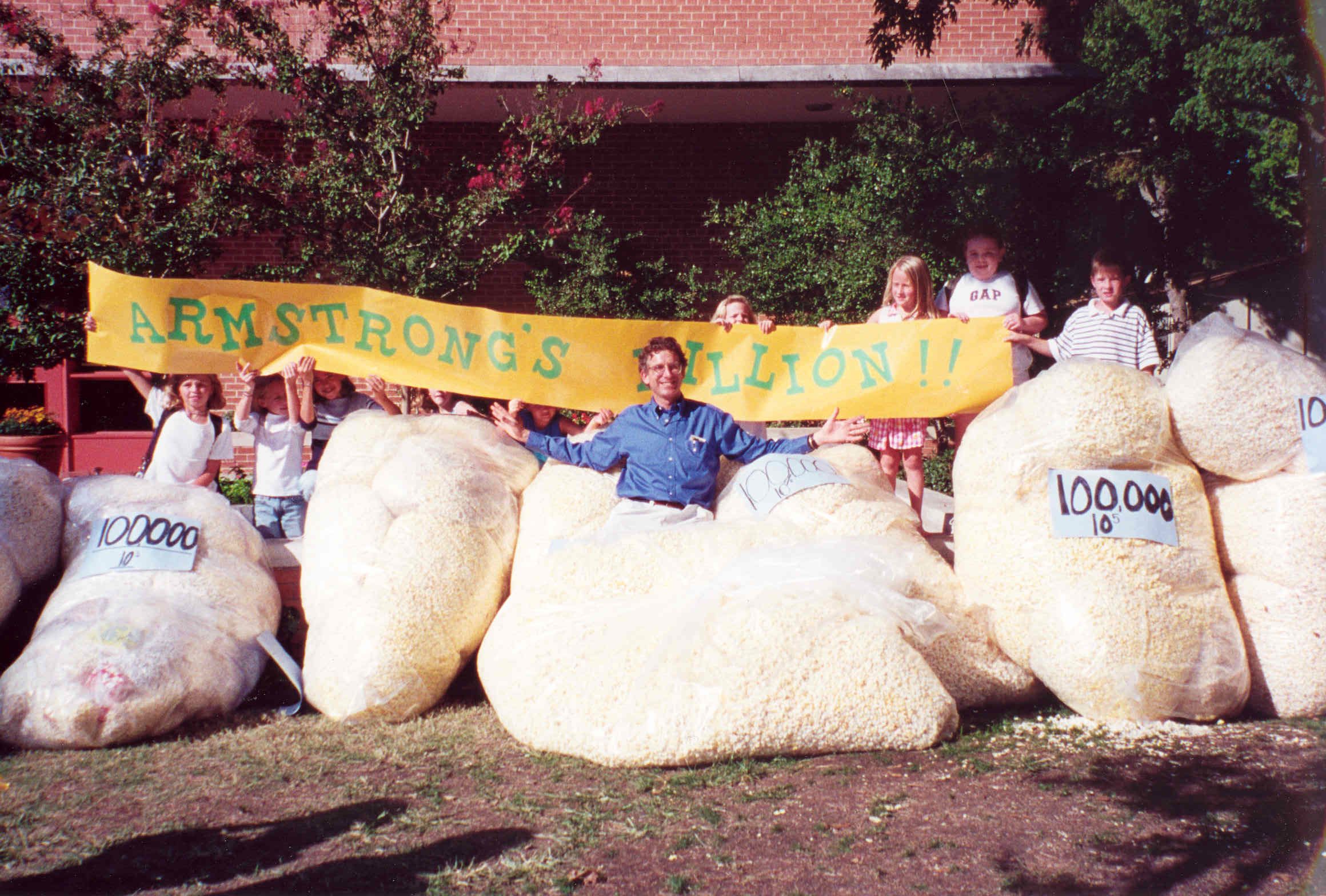
One Million Pieces of PopcornI know how to get kids really excited about math. Show them popcorn. Lots of popcorn. It’s one of my math props when I speak at schools. I pull out bags of popcorn that grow by powers of ten from one to ten to one hundred to one thousand and so on. Are you wondering how big the bags get? That’s exactly what the kids are wondering, and they’re at the edge of their figurative seats waiting to find out (I say “figurative” because they’re usually sitting on the floor). Their growing excitement is abated only momentarily when I tell them they won’t get to eat my popcorn (and wouldn’t want to eat it because I popped it in 1985). They groan but immediately go back to screaming with delight as a bag of popcorn ten times larger than the last one appears before their eyes. 

For years I’ve been using popcorn to demonstrate various math concepts as I act out the plot, if you can call it that, of On Beyond a Million, my powers-of-ten counting book. The popcorn almost never fails to excite children from grades K to 5 or 6, whether they are urban or rural, rich or poor, white or black, X or Y.  On several occasions I dropped the popcorn from my presentation, but I had to put it back because it’s so popular. 

The fact that 21st century children go wild over popcorn as a math prop encourages me wildly. Why? Because popcorn is so simple. It isn’t a coveted, rare treat that they hardly ever get to see (or taste). They haven’t been barraged by commercials touting its pleasures. There’s nothing high-tech about my bags of popcorn, and no special effects. There isn’t even an on/off switch. Yet kids love it because of the way the bags’ growth in size appeals to their senses and their emotions.

Much has been written recently about the current plugged-in generation that can’t have fun without electric outlets at hand and electronic devices in hand. Richard Louv’s best-selling book, Last Child in the Woods: Saving Our Children from Nature Deficit Disorder, sounds an alarm that children who are alienated from nature suffer in many psychological and physiological ways. Elementary school curricula may teach students all about the Amazon rain forest’s endangered species but do not encourage them to interact with the natural world outside their classroom, says Louv. That interaction, when it does occur, has a wealth of salubrious effects.

I am encouraged by the popcorn. If kids can get so excited about something as simple as my popcorn, then there is hope. For instance, if adults simply expose children to “nature play,” they will drink in the benefits.

Something else without an on-off switch comes to mind: books. In recent years, pundits have predicted death knells for the paper-and-ink variety of reading material but I don’t see it coming. Like big bags of popcorn, books are too much fun to hold and behold. They’re going to stick around for a while. Furthermore, as an author, I find the popcorn factor instructive. It says I can stick with the basics. By basics, I don’t mean what that word has come to mean in the politicized world of education and testing. I mean the basic and universal emotions and responses in children (shared by adults who haven’t lost the basics). One of the most valuable pieces of advice I ever got from an editor was in reference to a fiction manuscripts, Super Grandpa, but I think it applies to non-fiction as well. This editor told me to “cut to the emotional core of the story.” The emotional core of powers of ten is that every time you add a zero to a number, it gets ten times bigger and that’s WAAAAAAAAAY bigger. “WAAAAAAAAAY bigger” is the emotional core. It’s exciting. If I can get to that in my readers  (or audience members),  I’ve reached them. Just pop up some corn and you’ll see what I mean.

Share your thoughts..

Next Page »

  • Categories

    • Random
    • Math Moments
    • Travel
    • Books
      • Super Grandpa
      • If Dogs Were Dinosaurs
      • How Much is a Million?
      • Millions to Measure
      • If You Made a Million
      • G is for Googol
      • If You Hopped Like a Frog
      • Q is for Quark
      • On Beyond a Million
    • Stories
    • Lesson Plans
    • General
    • Fun Stuff
    • Resources
      • Lesson Plans
    • I.N.K
  • Pages

    • Home
    • Blog Home
    • Math Moments
    • Resources
      • Magic of a Million Activity Book
    • David Schwartz Visit
  • Archives

    • January 2010
    • December 2009
    • October 2009
    • September 2009
    • August 2009
    • July 2009
    • May 2009
    • April 2009
    • March 2009
    • January 2009
    • September 2006
    • July 2006
  • Links

    • Books - Books by David Schwartz
    • I.N.K. - Interesting Nonfiction for Kids
    • Presentations - David’s Presentation Information
    • Resources - Resources from David and Others
    • Schedule - David’s Speaking Schedule

Admin Login

Powered by frugal


Copyright © 2010 David M. Schwartz