When food is served, math can be dished up at the same time. Children will be eager to help themselves to both the meal and the math.
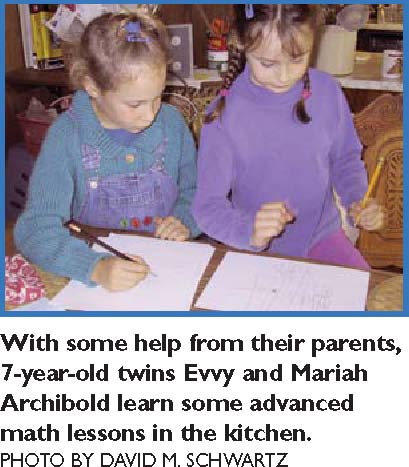
Most days, four people dine at the Archibold home, but today company’s coming. There will be five for lunch. The frittata is out of the oven. Soon it will have to be cut by 7-year-old twins Evvy and Mariah.
 Mom: How many pieces should we make?
Evvy: Five.
Mom: Why?
Evvy: There are five people.
Mom: Do you think everyone will eat the same amount?
Mariah: No. Adults eat more.
It is decided that the three adults will each get two pieces while the children will have one. Of course, the girls have to figure out how many pieces are needed all together.
Mariah (after thinking): Eight.
Dad: How do you know?
Mariah: There are three adults, so that’s one-two… three-four… five-six… and the kids have one each, so that’s seven and eight.
Dad: So how can we cut the frittata into eight pieces?
Out come paper and pencils so they can draw up their plans for dividing the frittata into “eighths” (a term adults can use without explanation, since it is obvious from context). Several division schemes are considered before the idea of two rows and four columns emerges as the winner. But another possibility is suggested:
Mom: Suppose we wanted 12 pieces. How would you divide the pan?
Soon the girls are inventing their own scenarios and solving them without prompting. Thinking ahead, Mom shows Evvy and Mariah the cake they will have for dessert. She complicates the problem in a new way.
Mom: Let’s eat half of it today and save the rest for tomorrow. How should we cut it?
Even something as simple as setting the table can be a math lesson for young ones: Count the number of plates, glasses and cutlery to be carried to the table. How does it change when there are guests? With one knife, one spoon, one fork and so forth for each setting, the young tablesetter is dealing with the basic math concept of matching, or “one-to-one correspondence.”
When Evvy and Mariah had to divvy up the frittata so that the three adults each got two and the two children each got one, they were actually being exposed to algebra! A middle-school math teacher might have expressed it more abstractly, but by the time these girls enter middle school, they will easily be able to understand the frittata problem as an algebraic equation.
When they tried out different combinations of rows and columns, they were learning not only about area and geometry, but basic multiplication visualized in a grid. Their parents did not proclaim “Right!” or “Wrong!,” but instead asked the children to justify their thinking, a strategy that helps kids think clearly about whether their answers make sense.
In the few minutes before lunch, Evvy and Mariah solved real life, real food problems with math. What could be tastier? Math Moments are an appropriate side dish to any meal.
Math Moments™ creator David Schwartz spends much of his time finding unusual, whimsical ways to make math and science come alive for kids and teachers, both through writing and through speaking at schools and conferences. He has written nearly 50 books for kids, including How Much Is a Million? and the “Look Once, Look Again” series.
Share Your Math Moments
David Schwartz would love to include your family’s Math Moments in this column. Send your stories and photos, along with your name and mailing address. David will award a signed copy of one of his books to those whose submissions he uses in this column.
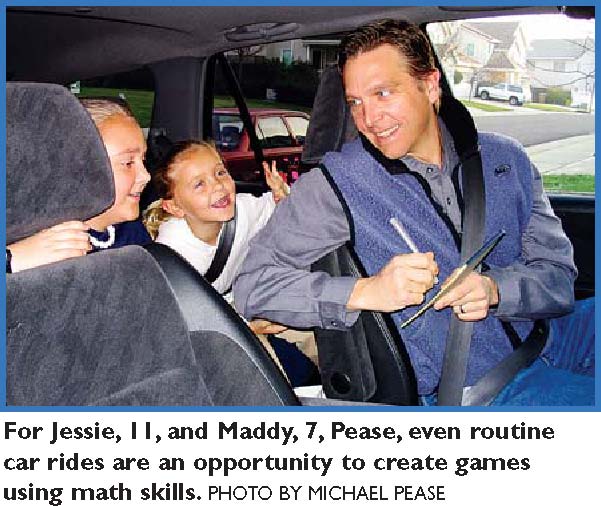 “Take the number of sides of a hexagon… double it… take two from that… take half of that. What do you get?”
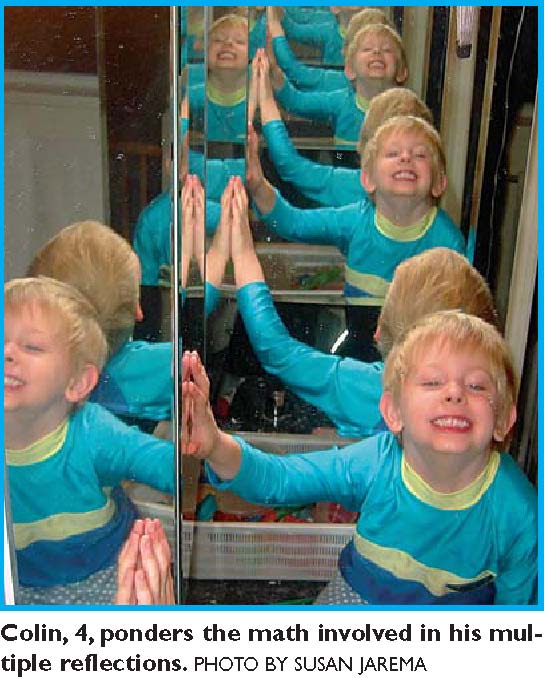 Moments before bedtime one evening, Colin wonders how many seconds he has lived. Susan can’t resist pulling out a calculator to answer the question: More than 100 million seconds! Not to be outdone in bedtime extensions, Maya suggests this scenario: “If we had 27 kids and they each fought with each other once, how many fights would that be?”
 Nine-year-old Brien cannot believe his mom is asking him the weight of a cow at the county fair. But Chris Nugent knows a Math Moment when she sees one. She doesn’t expect her son to know the cow’s weight, but she knows he can use some math to come up with a reasonable estimate. Finally, he compares the cow to his mother and decides that the cow weighs five times as much as she does. Being compared to a cow might not flatter his mom, but Chris likes Brien’s approach to the problem. He announces the cow’s weight.
 “Ninety-five,” Grace Linderholm, 10, said confidently. “More,” said her sister, Amelia Gurley, 12. “Way more, like 250.”
 In Minnesota, the Harts stop to ponder the proportions of a famous steel and concrete figure of Paul Bunyan and his blue ox Babe, which towers over the mortals who stop to admire. How large are the outsized figures? Kids love guessing games, and this can be a quick estimation activity: Josh is almost 5 feet tall, and Big Paul looks to be as high as four of Josh … so the lumberjack must be a little less than 20 feet. (Checking the sign after estimating reveals that the technique works: the statue is 18 feet high.) Now spread the fun (and the math) around: Kallie, at 52 inches, can be a benchmark to gauge Babe’s oxenly dimensions. And how many Marissas, end to end, would it take to span the big bovine’s horns? Now that’s a longhorn!
 She tells him that they need a 1-inch hem, and folds some fabric to demonstrate. She sets her “hem gauge” (a 6-inch ruler with sliding pointer) to 1 inch and shows Ty how to use it.
 “When we find them, we read them and talk about them,” says Cathy. Elizabeth doesn’t need any prompting. She is pointing and reading the house numbers posted on a wooden retaining wall outside a neighbor’s home. “One–eight–four–eight,” she says with obvious satisfaction.
 Sam’s grandmother didn’t have a large space to work with – all the more reason that Sam had to plan carefully. First, he measured the area that was to be planted, including landscape features that could not be altered – walkways, fences and a concrete pillar. Scaling down the dimensions to notebook size, he sketched the area, then drew in the plants.
 “How much bigger?” asked her mother, Joanne. It was an opportunity for Miya and her mom to compare sizes:Was the biggest icicle twice as large as the smallest one, or more? By holding the icicles next to each other and “walking” the little one up the side of the big one five times, Miya could easily see how many times bigger the “papa” icicle really was.